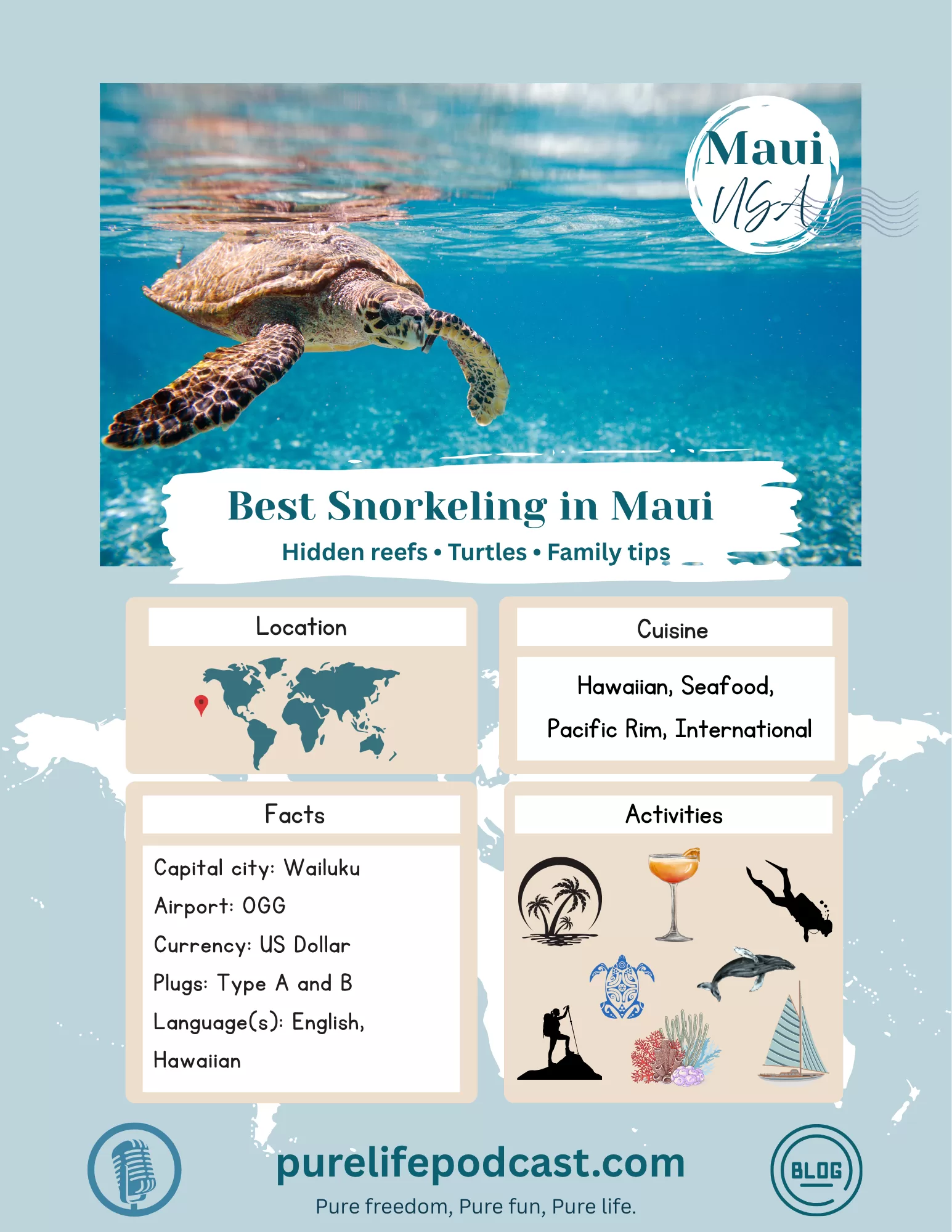
Exploring Maui’s Reefs as a Family
Irasshaimase — welcome to Pure Life Podcast! Maui’s reef-fringed bays, volcanic coastline and colorful marine life keep calling us back. Our family has spent countless trips exploring Hawaii’s reefs over the years, and Maui remains one of our favorite places to slow down and watch the underwater world.
This guide brings together seven snorkeling locations from our travels, with practical advice for couples and families. Choosing where to snorkel starts with today’s conditions, your ocean-swimming ability and an entry and exit you can manage comfortably. A famous beach or beautiful photograph cannot tell you whether the water is suitable that day.
For the rest of your vacation, our Ultimate Maui Itinerary — 3, 5 & 7 Days helps you balance ocean time with exploring the island.
Following the devastating August 2023 Lahaina wildfires, recovery and rebuilding continue. West Maui welcomes visitors in accessible areas, while affected neighborhoods still need privacy and respect. Check Maui County’s recovery and access updates, follow restrictions and support local businesses that are welcoming guests.
Short on Time? Where Should You Snorkel in Maui?
- For a beach-and-snorkeling day: Mōkapu Beach in Wailea combines a sandy beach with nearby reef when conditions suit your ability.
- For a memorable boat excursion: Molokini offers a distinctive offshore setting; weather can change the itinerary.
- For experienced ocean swimmers: Honolua Bay can be rewarding in favorable conditions, with a rocky entry and winter-surf concerns.
- For convenient resort-area access: The reef near Westin Kāʻanapali Ocean Resort Villas and Black Rock are accessible from shore. Black Rock deserves particular caution around currents, boats and jumping areas.
- For families: Prioritize swimming ability and a lifeguarded beach where possible, rather than choosing by popularity.
PLP Tip: No Maui snorkeling location is guaranteed to be calm or safe every day. Check conditions before entering, snorkel with a buddy and keep a land-based alternative in your plans.
This guide contains affiliate links; we may earn a commission at no additional cost to you.
Table of Contents
FIRSTHAND ISLAND INSIGHTS · FREE HAWAII TRIP PLANNER
Which Hawaiian Island Is Right for You?
Choose your island around your interests, your pace and what you want from your vacation. Compare Oahu, Maui, Kauai and the Big Island with firsthand guidance from more than three decades of Hawaii travel.
Free 4-page PDF · Sign up to receive your guide
Check your inbox to confirm your subscription and download your planner. You’ll also receive Pure Life Podcast travel emails. Unsubscribe anytime.
Our Seven Maui Snorkeling Spots
1. ʻĀhihi-Kīnaʻu Natural Area Reserve — South Maui
This protected lava coastline south of Mākena is appealing for its coral and variety of reef fish, including tangs, Moorish idols and parrotfish. Access is from shore at designated open areas; this is a conservation reserve rather than a sandy resort beach.
Access and suitability: Rocky, slippery entries favor confident ocean swimmers. Use the designated parking area and marked routes; do not cross closed lava fields. DLNR’s reserve page and activity map list current hours, fees and restrictions. Posted visiting hours are 5:30 a.m.–7:30 p.m., with a $10-per-car day-use fee payable by card; check before visiting.
Ocean and reef care: Skip it when swell, wind or surge makes entry or exit difficult. Foot protection can help on access paths, but never stand on coral or collect marine life.
PLP Tip: Bring appropriate footwear for the rocky approach, and choose your exit before entering. Footwear does not make a rough-water entry suitable.
2. Mōkapu Beach — Wailea
A sandy beach and reef near the adjoining Ulua–Mōkapu area make this an appealing South Maui beach day. Turtles may pass through, but sightings are never promised.
Access and suitability: Shore access is via the public Ulua–Mōkapu beach access, with parking that can fill. Families with capable ocean swimmers may enjoy it in suitable conditions; being near a resort does not make it a supervised snorkeling area.
Ocean and reef care: Wind, shorebreak and south swell can change conditions, including in summer. Stay clear of rocky surge zones and give turtles space.
PLP Tip: We favor an early arrival for parking and time to assess the water. Morning is a planning preference, never a promise of calm seas.
3. Honolua Bay — Northwest Maui
A shaded forest trail leads to one of our favorite Maui snorkeling settings: a beautiful bay with coral along its sides and colorful reef fish. The forest and cove are part of the appeal even on a day when we would stay out of the water.
Access and suitability: Shore access involves a rocky shoreline; limited roadside parking requires care, legal spaces and respect for private land. There are no facilities. This is a better choice for experienced ocean swimmers who can judge the entry, exit and swim distance.
Ocean and reef care: Runoff can cloud the inner bay. Avoid murky water and high surf; DLNR advises avoiding these waters during winter months, when high surf is common. Do not treat a summer visit as assurance of suitable conditions. Leave coral and marine life undisturbed.
PLP Tip: Bring insect repellent for the humid, shaded walk and carry out everything you bring in.

4. Reef Fronting Westin Kāʻanapali Ocean Resort Villas — North Kāʻanapali
The reef in front of the villas is a highlight of our family’s Maui memories. We remember a large mushroom-shaped coral and a turtle sheltering nearby; we have also seen reef sharks pass through. Those are observations from past visits, not a promise of present reef condition or wildlife sightings.
Access and suitability: This is shore snorkeling along North Kāʻanapali, rather than a boat-only reef. Guests have convenient beach access; day visitors should use signed public access and legal public parking rather than assume resort parking or facilities are included.
Ocean and reef care: Assess the shorebreak, wind, current and exit before entering. Stay clear of rocks, boats and coral, and leave wildlife a clear route to move away. Resort proximity does not remove ocean hazards.
PLP Tip: For more space and kitchen facilities, the villas can be a practical base. Verify the exact villa category and occupancy for your whole party.
Westin Kāʻanapali Ocean Resort Villas — Check rates for your dates →


5. Black Rock / Puʻu Kekaʻa — Kāʻanapali Beach
At the northern end of Kāʻanapali Beach, Black Rock combines dramatic volcanic scenery with shore-access snorkeling near the Sheraton. Fish and occasional turtle or ray sightings are part of its appeal, but its popularity should never be mistaken for beginner suitability.
Access and suitability: Use public beach access and signed parking, allowing for a walk and possible parking charges. Confident ocean swimmers still need to assess conditions. Strong currents can occur near the point; do not round it or swim farther out simply to follow fish.
Ocean hazards: Keep clear of cliff-jumping and landing areas, boats and vessel routes. Waves, shorebreak and currents can change throughout the day. Hawaii Ocean Safety links to a specific public-health warning about Black Rock; we would not use it as a default first snorkeling outing.
PLP Tip: The Sheraton has beach equipment rentals; confirm current availability, charges and guest restrictions directly. Its sunset cliff-dive ceremony is something to watch from shore, well away from the landing area.
Sheraton Maui Resort & Spa — Check rates for your dates →
Prefer a guided boat outing? A West Maui half-day snorkeling cruise from Kāʻanapali can provide equipment and crew support, with stops chosen for conditions. Check swimming and age requirements, beach-boarding arrangements, parking and cancellation terms. It is optional; suitable shore snorkeling does not require a commercial excursion.

6. Mākena Landing — South Maui
This small coastal access south of Wailea offers shore snorkeling along a rocky reef where turtles are sometimes seen. Limited parking and a mix of swimmers, kayaks and small craft make a considerate approach important.
Access and suitability: Use the public park’s designated parking and entry areas, keep the launch area clear and confirm your exit. Rocks, surge and swimming distance make this a choice for confident ocean swimmers in suitable conditions, rather than an automatic family recommendation.
Ocean and reef care: Avoid high surf, poor visibility and runoff after rain. Do not swim farther offshore to follow turtles; keep your distance and never block their path to the surface.
What “Turtle Town” Actually Means
Turtle Town is a general name used for reef areas along the South Maui coast, not a single precisely defined beach. Shore-access possibilities include the Mākena Landing and Maluaka Beach areas when access and conditions permit. Other reefs are visited by boat. An organized tour is optional for suitable shore snorkeling; it does not guarantee turtles or remove swimming requirements.
7. Molokini Crater — Offshore Boat Excursion
Molokini’s crescent-shaped volcanic setting and reef fish make it a distinctive ocean outing. It is offshore, with no beach access from Maui: visitors normally join a permitted boat excursion. Visibility varies, and wind or swell can mean a different destination or cancellation.
Planning and suitability: Check the departure harbor, parking, check-in time, swimming ability, minimum age and boarding requirements before booking. Allow driving time from your accommodation. Crew support and flotation equipment do not make open-ocean snorkeling suitable for everyone.
Check dates for a Molokini and Turtle Town snorkeling boat trip → This listing departs from Kīhei; confirm the current meeting instructions and itinerary. A Turtle Town stop and wildlife sightings remain subject to conditions.
PLP Tip: A shorty wetsuit has helped members of our family, including our daughter, feel more comfortable in the water. Ask the operator about fit and rentals, and get out before feeling cold or tired.
PLP Tip: One of our family members became quite seasick on the ride to Molokini. The crossing can be choppy even on an appealing day; discuss suitable motion-sickness options with a pharmacist or clinician before departure.
Combining islands? Our Oahu snorkeling tour booking tips cover questions to ask when comparing guided ocean outings.


When to Snorkel in Maui and How to Plan Your Day
Season Matters, but Daily Conditions Come First
Winter swells often make north-facing and exposed northwest bays unsuitable for snorkeling. Summer can offer more opportunities there, while south swells can affect Wailea and Mākena. Wind, storms and local currents matter in every season: neither South nor West Maui is guaranteed calm in winter.
Daylight mornings often offer a better planning window before wind builds, but check the forecast and shoreline first. Avoid dawn, dusk and murky water. Give yourself time to rest after travel, learn your equipment and change plans if anyone feels tired or uncertain.
Getting Around Maui
A rental car makes it easier to reach scattered beaches with gear and to adjust plans. Maui has public buses, but they may not fit early beach outings or tour check-in times. Compare transport costs with your itinerary rather than assume a car is essential for every resort stay.
Compare Maui rental cars for your dates → Check the total cost, parking charges and rental conditions. Airport pickup at Kahului (OGG) is convenient, but compare it with other options.
Keep a Land-Based Alternative
We like leaving room for the Road to Hāna, Haleakalā, a pineapple farm visit or a waterfall walk on another day. Check each attraction’s current access, reservations, weather and trail guidance; waterfalls and streams need particular caution after rain. A full scenic outing deserves its own day rather than being squeezed around an offshore trip.


Where to Stay in Maui
We’ve personally stayed at the four resorts below and recommend them for different combinations of space, comfort and location. For a family of five, confirm the exact room or villa category, bedding, occupancy limits and total charges; not every room sleeps five.
- Westin Kāʻanapali Ocean Resort Villas: A practical choice for villa space, kitchens and beach access. Choose the precise unit size you need. Check rates for your dates →
- Sheraton Maui Resort & Spa: Convenient for Kāʻanapali Beach and Black Rock scenery, with the ocean cautions discussed above. Check rates for your dates →
- Aston Kāʻanapali Shores: An option for apartment-style space and a flexible family base; compare room types carefully. Check rates for your dates →
- The Ritz-Carlton Maui, Kapalua: A comfort-luxury base for the Kapalua area. Nearby beach access does not guarantee suitable snorkeling conditions. Check rates for your dates →
PLP Tip: The Westin villas are a different property from The Westin Maui Resort & Spa. Check the property name and exact accommodation category before reserving.
For more of our firsthand accommodation experiences, see our hotel picks for families of five.
Where to Eat After Your Beach Day
These are options to consider around your base. Use the restaurants’ own sites for current hours, menus, reservations and location details.
- Tin Roof, Kahului: Local plates associated with chef Sheldon Simeon.
- Miso Phat, Kīhei: Sushi at the Maui Coast Hotel; check its current location before setting out.
- Mama’s Fish House, Pāʻia: A special-occasion seafood stop; plan reservations ahead.
- Merriman’s Kapalua: Oceanfront dining with a focus on Hawaii ingredients.
- Star Noodle, Lahaina: Noodles and Asian-inspired sharing plates; its site lists 1287 Front Street.
- Honu Oceanside, Lahaina: The oceanfront restaurant formerly known as Honu Seafood & Pizza. Check the current menu and reservations directly.
PLP Tip: Honu is one of our family’s favorite Maui restaurants; we’ve shared many sunset dinners overlooking the ocean. Those memories are part of why we value supporting Lahaina’s locally owned restaurants with patience and respect.


Ocean Safety and Reef Protection
Before Entering the Water
- Read today’s ocean: Check current beach conditions and weather alerts. Choose a lifeguarded beach where possible and ask the lifeguard about hazards. Many snorkeling coves are unguarded.
- Match the swim to your ability: Hawaii Ocean Safety advises that snorkelers be experienced ocean swimmers. Check the entry, exit, surf and current; stay out if unsure. A sheltered-looking bay can still be hazardous.
- Use a buddy and pace yourself: Stay close enough to notice distress. Practice with properly fitted gear, supervise children closely and return before fatigue. Flotation adds support but does not replace swimming ability.
- Know when to stop: Leave the water if breathing feels difficult, you feel unwell, cold or anxious, or conditions worsen. Do not push through discomfort.
- Skip poor water conditions: Avoid snorkeling after heavy rainfall, in brown or murky water, near runoff, during high surf or where warnings are posted. Check water-quality advisories as well as surf reports.
Read Hawaii Ocean Safety’s snorkeling guidance before your trip. These precautions reduce risk; none guarantees safety.
Give Protected Wildlife Space
Never touch, chase, feed or surround marine animals, and leave them room to surface or return to the sea. NOAA’s Hawaii guidance recommends at least 10 feet from turtles, 50 feet from monk seals and 150 feet from mother seals with pups. These are viewing recommendations, not a universal statutory minimum for turtles or seals; disturbing protected animals can still violate the law.
Legal distance rules: Federal rules prohibit swimming with, approaching or remaining within 50 yards of Hawaiian spinner dolphins, and approaching humpback whales within 100 yards in Hawaii. Follow posted barriers and any stricter instructions.
Protect the Reef
Keep hands, feet and fins off coral; never stand on it, collect it or anchor on a reef. Carry out litter and avoid disturbing the seabed.
Sunscreen: Maui County prohibits the sale, distribution and use of non-mineral sunscreen without a prescription. Choose zinc oxide or titanium dioxide active ingredients; the county recommends non-nanotized formulations. A “reef-safe” label alone is insufficient. Rash guards, hats and shade reduce reliance on sunscreen.
Maui Planning Essentials
Kahului Airport (OGG) is the main arrival point. Pack a towel, drinking water, sun protection and appropriate footwear. Water temperature and comfort vary with season, depth and time in the water; ask your operator or rental shop about a wetsuit rather than rely on one island-wide temperature range.
Maui Snorkeling FAQs
Where is the best snorkeling in Maui?
Our favorites include the reef near Westin Kāʻanapali Ocean Resort Villas and Honolua Bay in suitable conditions. Mōkapu offers a beach-day option, while Molokini is an offshore outing. The best choice is the one that matches today’s water and your swimming ability.
Can you snorkel directly from the beach in Maui?
Yes. Several locations in this guide have shore access, including Mōkapu, North Kāʻanapali and Mākena Landing. Check legal access, entry and exit conditions, and parking. Shore snorkeling can be hazardous even close to the beach.
Where can you see sea turtles in Maui?
Turtles may be seen around South Maui’s Turtle Town reefs and parts of Kāʻanapali, among other areas. Sightings are never guaranteed. Watch from a distance and never chase an animal or block its access to air.
Is Molokini worth visiting?
It can be a memorable choice for its offshore volcanic setting and reef fish if you enjoy a boat outing and meet the operator’s requirements. Consider crossing time, seasickness, price and flexibility: weather can change the destination.
Is Turtle Town accessible from shore?
Some parts are, including reef areas reached from Mākena Landing and Maluaka Beach when conditions and access permit. Turtle Town is a general coastal name, not one designated beach. Other sites are visited by boat; a tour is not universally required.
Is Black Rock suitable for beginners?
We would not choose it as a default first outing. Currents near the point, changing surf, boats and cliff-jumping areas add hazards. Beginners should first build swimming and equipment skills and seek local guidance at a suitable lifeguarded beach.
What is the best time of year for Maui snorkeling?
Summer often offers more opportunities along northern shores, while winter north swells can rule them out. South shores can receive summer swell. Check the daily forecast and local advice instead of relying on a season alone.
What should families know before snorkeling in Maui?
Each person needs the swimming ability and confidence for that site. Use a buddy, closely supervise children, check entry and exit conditions, practice with fitted gear and stop before fatigue. A tour or flotation device cannot make unsuitable conditions appropriate.
Can you snorkel safely in Maui during winter?
Suitable opportunities may occur, but no shore is guaranteed safe. Winter swell frequently affects exposed northern and western sites, and DLNR advises avoiding Honolua’s waters during winter months. Seek current local advice and be ready to stay ashore.
Do you need a snorkeling tour?
Not for independently accessible shore locations when conditions match your skills. Molokini normally requires a boat excursion. A guided outing may help with logistics and local knowledge, but check swimming requirements and do not assume a particular reef or wildlife encounter is guaranteed.
Do you need to bring your own snorkel gear?
No. Rentals are available, but check fit and learn how to use the equipment before entering the ocean. We’ve had good experiences with Snorkel Bob’s knowledgeable staff and equipment on our past visits.
Do you need a rental car?
It is useful for exploring multiple beaches with gear. If you plan to stay near one resort or book transfers, you may need one for only part of the trip. Check transport to your specific tour departure point.

Our Final Thoughts on Snorkeling in Maui
We’ve explored these reefs for years as a family, learning to slow down, watch the fish and appreciate a turtle passing through without following it. The volcanic coast at ʻĀhihi-Kīnaʻu, the reef near our Kāʻanapali base and Black Rock’s evening scenery are part of why Maui keeps bringing us back.
Leave space in your plans for the ocean to change them. Respecting the reefs, supporting local businesses and choosing an outing everyone can manage comfortably matter more than ticking off a famous bay.
Plan your ocean day: Choose your base, compare the shore locations above and reserve a boat excursion only if it suits your group. Confirm current conditions, departure instructions and cancellation terms, then keep an alternative day available.
Explore More Hawaii Travel
Start with our Maui itinerary linked near the beginning, then use these guides for your next planning decision:
- Best Snorkeling in Oahu — 8 Spots We Recommend for Families — Compare shore locations and ocean cautions.
- Ultimate Oahu Itinerary — 3, 5 & 7 Days — Plan Waikīkī, Honolulu and days beyond the city.
- Best Oahu Family Resorts — Compare Waikīkī, Ko Olina and North Shore bases.
- Big Island Hawaii Vacation Guide — Combine snorkeling, volcanoes and island exploration.
- The Ultimate Kauai Hawaii Vacation — Explore the Garden Isle’s scenery and coastal experiences.
- Where to Stay in Hawaii — By Island & Travel Style — Choose the island and base that suit your trip.
For the wider collection, browse our Hawaii travel guides.
Every Journey, Once in a Lifetime.
Safe travels, matane — until next time.
Affiliate disclosure: This article contains affiliate links. We may earn a small commission at no additional cost to you. Access, conditions, hours, prices and operator requirements can change; check the linked official sources and providers before your visit.